 LOCK
LOCKTechnical brief · public · v1.1 illustrated · 16 August 2026
S◉LOCK Founding Brief
Origin, Lab civilisation, and the private AI OS path. What we can stand behind in public. What we refuse to publish.
Publisher: VF Empire Ltd · Company no. C 94160 · VAT MT26384195 · Malta · Download PDF · Story page · Lab depth · Trust
1. What this paper is
This is a Founding technical brief for people who want more than a landing page and less than a clone kit. It joins the origin timeline with the Lab backend that already runs the product work.
It is written for buyers, partners, and sceptics. It is not a peer-reviewed academic paper and not a security certification. Claims below are company-stated Lab scale and product posture. Independent audits are not claimed.
2. Origin
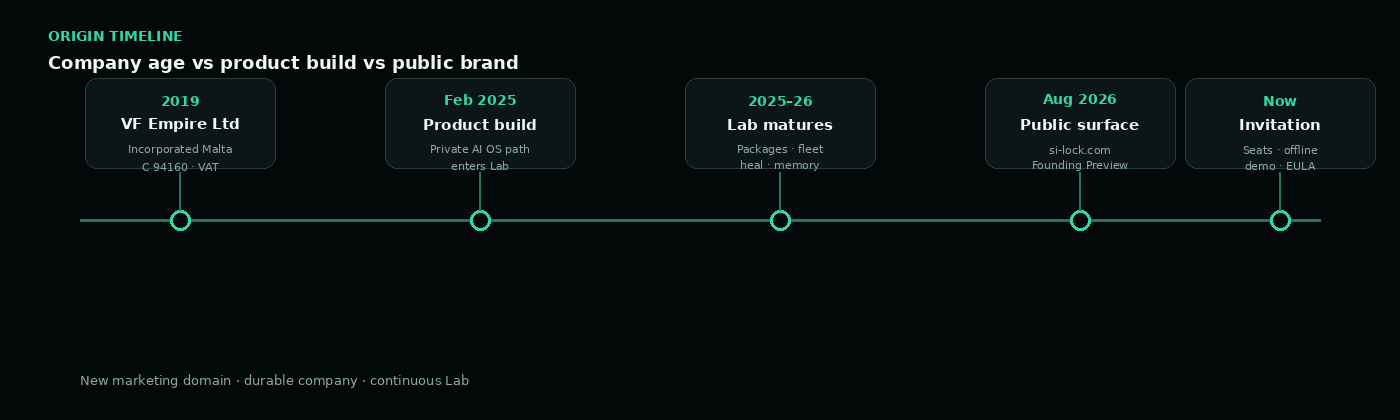
VF Empire Ltd has been a Malta company since 2019 (company no. C 94160, VAT MT26384195). The private AI OS path that became S◉LOCK entered active Lab build in February 2025. The public marketing domain arrived in August 2026 as Founding Preview. New site. Old company. Long Lab.
Most “AI on the desk” still means a browser tab rented from a data centre. Drafts and client work leave as tokens and return metered. Open-weight models made another path possible: intelligence on metal you own. A terminal demo is not enough. You need packages people open every day, hardware floors, update discipline, and a Lab that breaks builds before seats see them. That is the work that started in February 2025.
Short public narrative: si-lock.com/story.
3. What S◉LOCK is
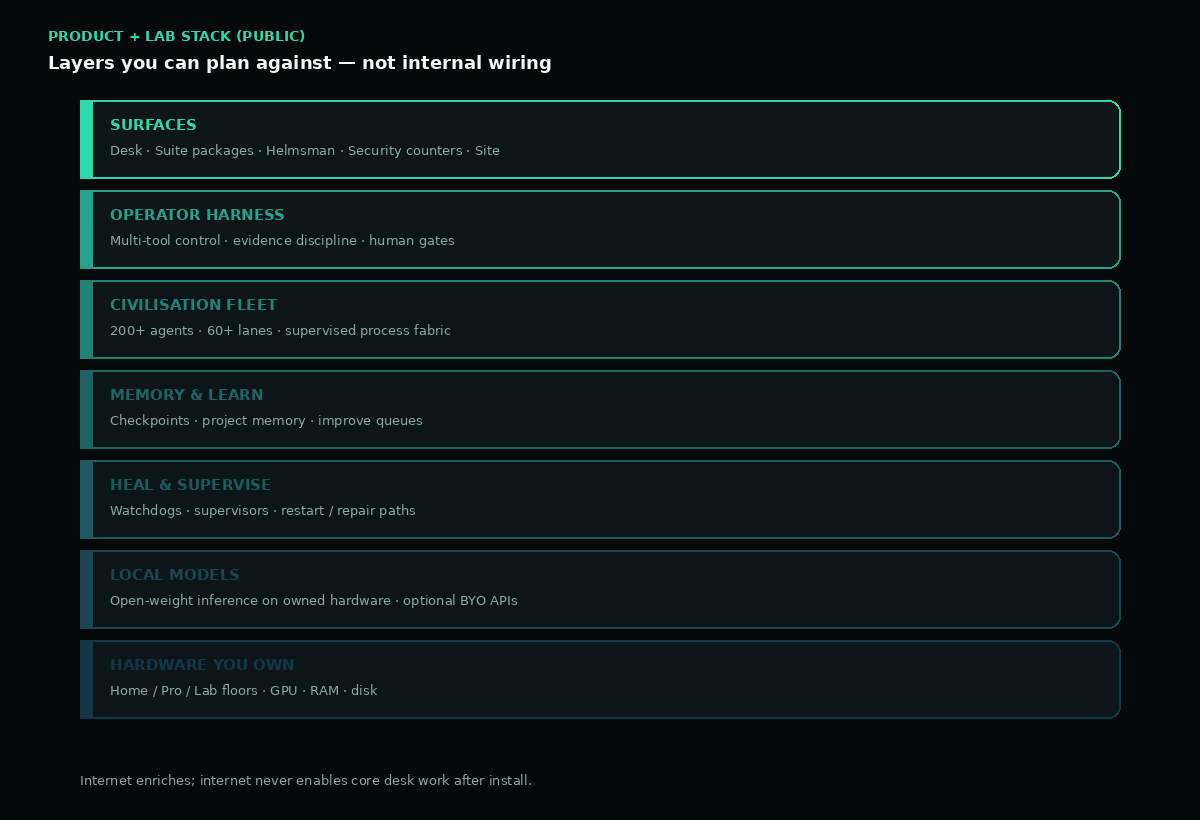
S◉LOCK is a private AI operating system layer: an AI-native private desktop path with installable creative and work packages, plus Helmsman for frontier open models on hardware you own. It sits on a real base OS. It is a product desk, not a multi-tenant cloud chat subscription.
Default posture: models, files, and inference stay on hardware you control. Optional cloud APIs only when you bring keys. Updates and licence checks may contact company endpoints; those paths are disclosed at delivery in the product EULA.
4. The Lab civilisation (backend)
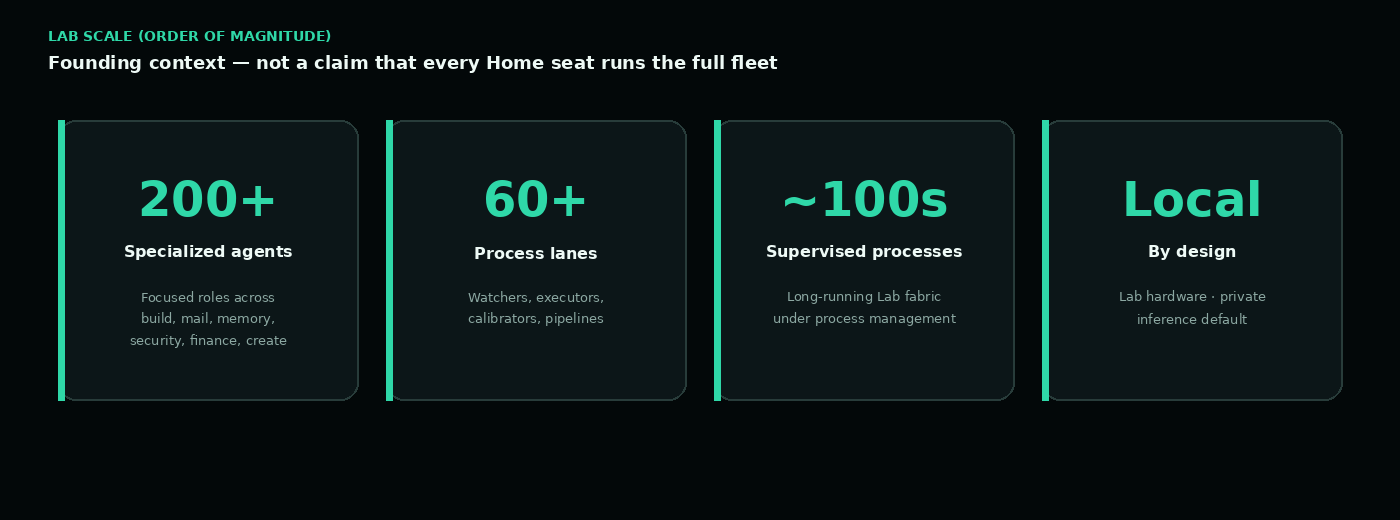
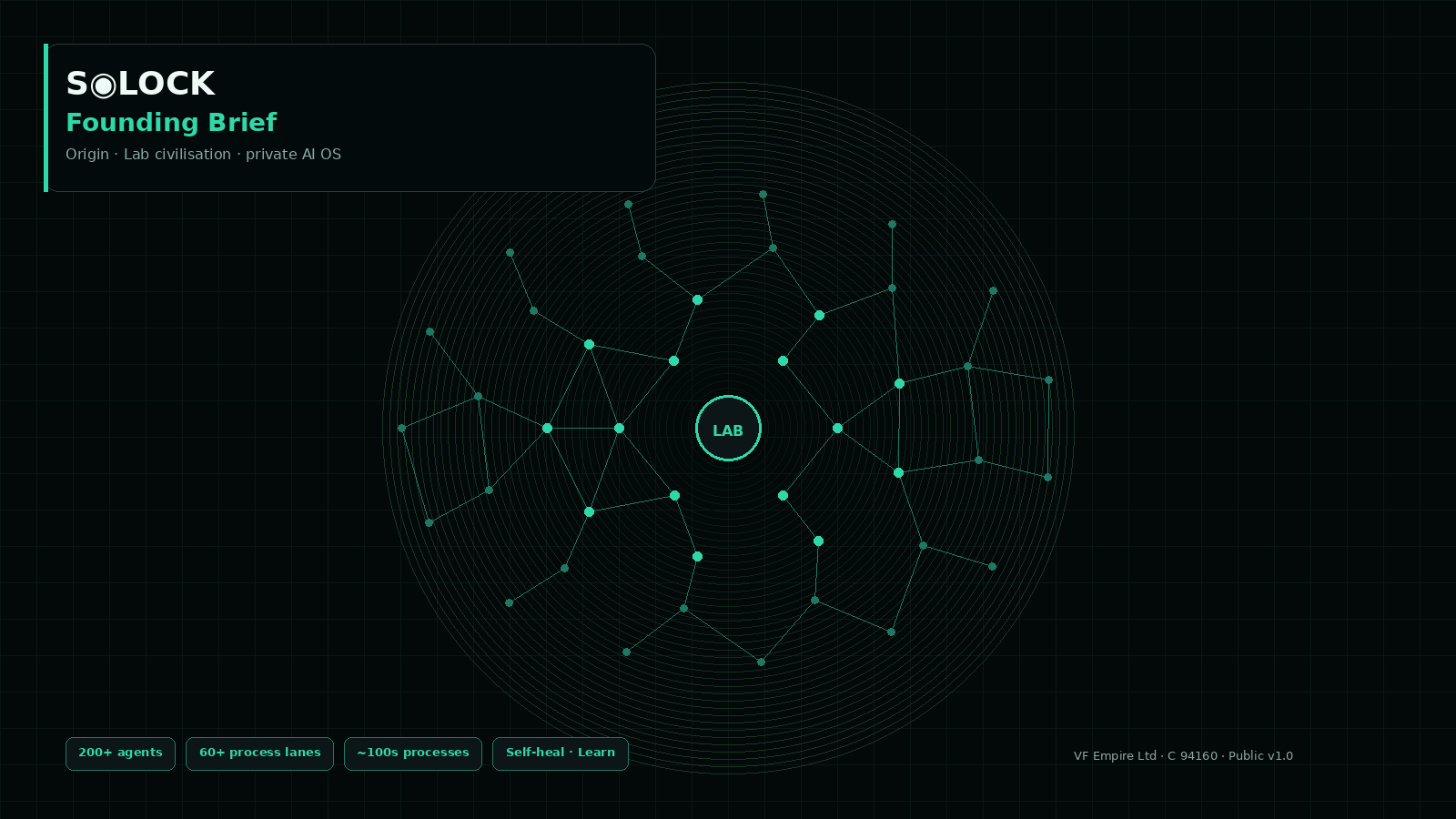
Behind the public brand sits a Lab that is already a multi-agent operating layer. We call it a civilisation because it is not one chatbot with plugins. It is a living fleet of specialized workers, long-running processes, memory, and heal loops that share one machine fabric under operator authority.
Numbers are Lab-scale order of magnitude for Founding context. They are not a promise that every Home seat runs the full Lab fleet. Product packaging matches hardware class.
4.1 Specialization (what agents are for)
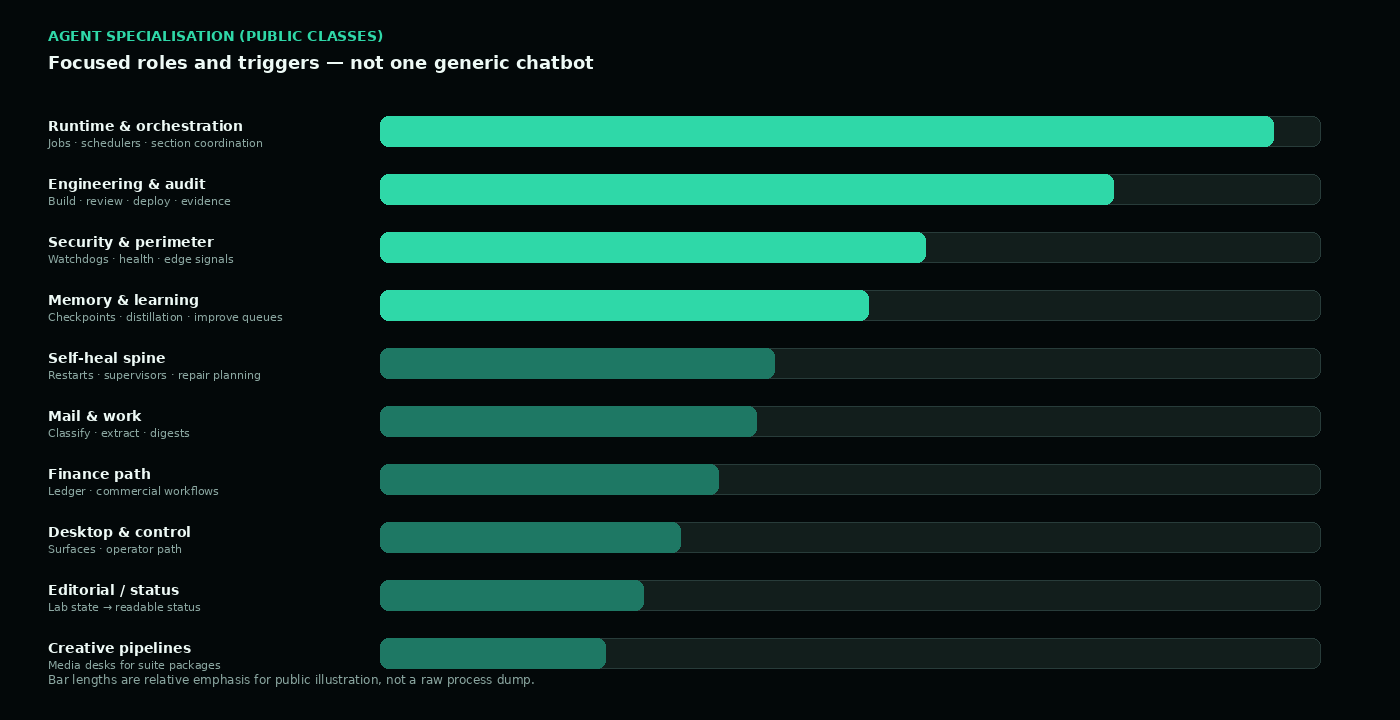
Agents are not generic personas. Each class has a job, inputs, and triggers. Public classes include:
- Engineering and audit — build, review, deploy discipline, evidence-first verification
- Mail and work — classification, extraction, digests, commercial paper trails
- Memory and learning — session checkpoints, project memory, distillation of what changed
- Security and perimeter — watchdogs, health polls, abuse and edge signals
- Finance path — ledger and commercial workflows toward Billit-class packages
- Editorial / status — internal newsroom discipline that turns Lab state into readable status
- Creative pipelines — media desks that feed Image, Video, Music, 3D packages
- Runtime and orchestration — job executors, schedulers, section coordination
- Self-heal spine — crash detection, restarts, supervisor heartbeats, upgrade proposals
4.2 Process lanes vs chat tabs
Chat is a surface. The Lab is process. Long-running workers keep watching mail, health, build state, and package pipelines whether or not a human is staring at a window. That is the difference between a demo and an operating layer.
5. How the organism works
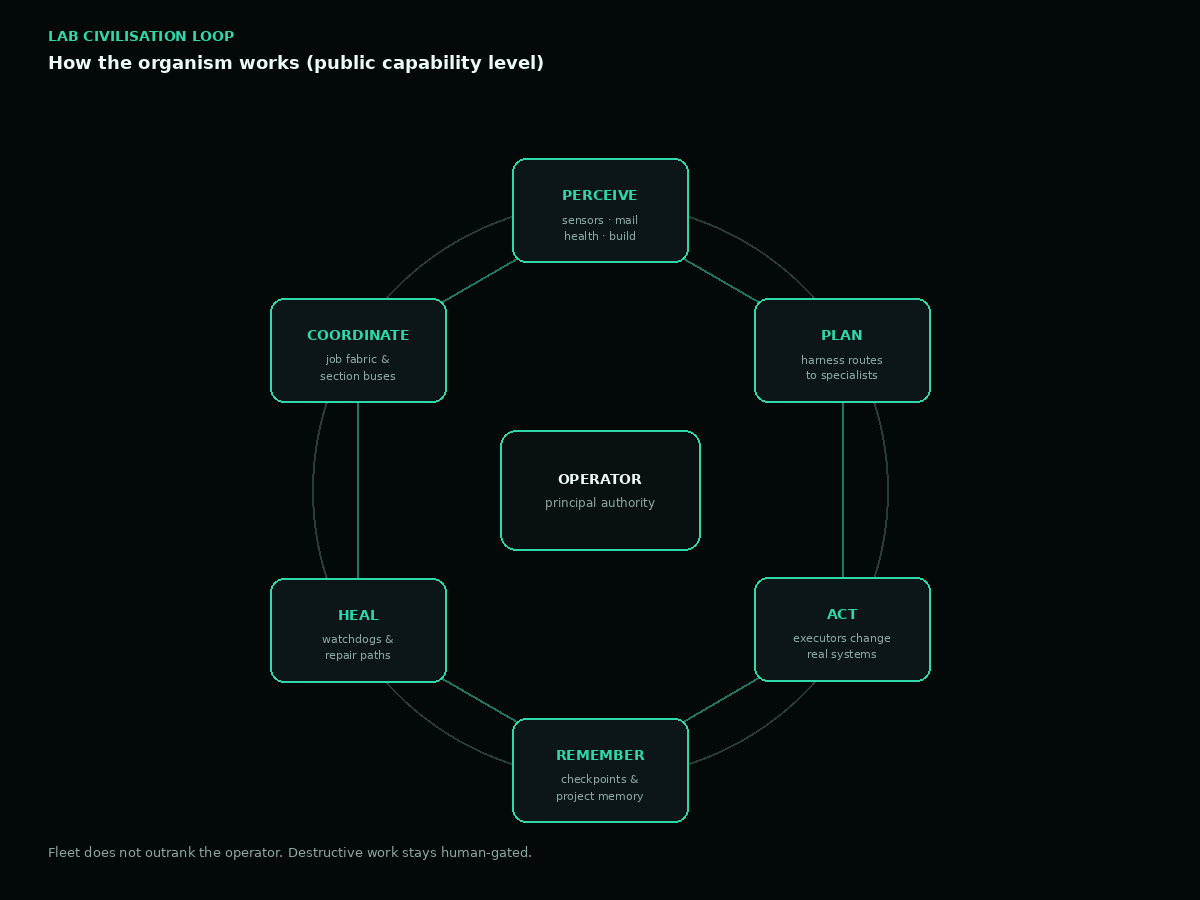
Public loop (capability level, not wiring diagram):
- Perceive — sensors, logs, mail, desktop, build state, health signals
- Plan / think — operator harness and job cortex route work to the right specialist
- Act — section agents and executors change real systems under policy
- Remember — project memory and checkpoints so work resumes across sessions
- Heal — flaps and failures trigger restarts, plans, or human-gated repair
- Coordinate — shared job fabric and section buses so specialists are not islands
Design laws that shape the Lab (stated as principles, not as full constitution text):
- Internet enriches; internet never enables. Core desk work must survive offline after models and packages are installed.
- No silent bypass of the kernel path. Model calls, tools, memory, and privileged actions go through controlled gates.
- Zero-trust agents. Specialists start with no rights. Capabilities are scoped, time-limited, and audited. Destructive work stays human-gated.
- Evidence over green badges. A task is done when it leaves proof on disk, not when a model claims success.
The human operator remains principal. The fleet does not outrank the operator. Automation is power under authority, not autonomy for its own sake.
6. Self-heal, self-improve, learn
The Lab is built to stay alive under load. Live mechanisms include process supervision, health watchdogs, cell supervisors, crash-path repair planning, and continuous census of what is running. When something flaps, the system tries to detect, restart, and escalate rather than hope a human notices first.
Learning is practical, not mystical:
- Session and project memory so work does not evaporate between days
- Distillation of what changed and what failed
- Improve queues that propose classify / heal / research work
- Promotion only after success checks (not silent god-mode self-rewrite of critical law)
Honesty: full self-healing OS dreams (shadow-test every patch, auto-promote kernel-class changes) are architecture targets with partial Lab reality today. Crash restarts and heal watchdogs are live. Risk-tier policy keeps high-impact changes under human approval. We do not claim a finished, fully autonomous self-modifying OS for every seat.
7. Privacy and network truth
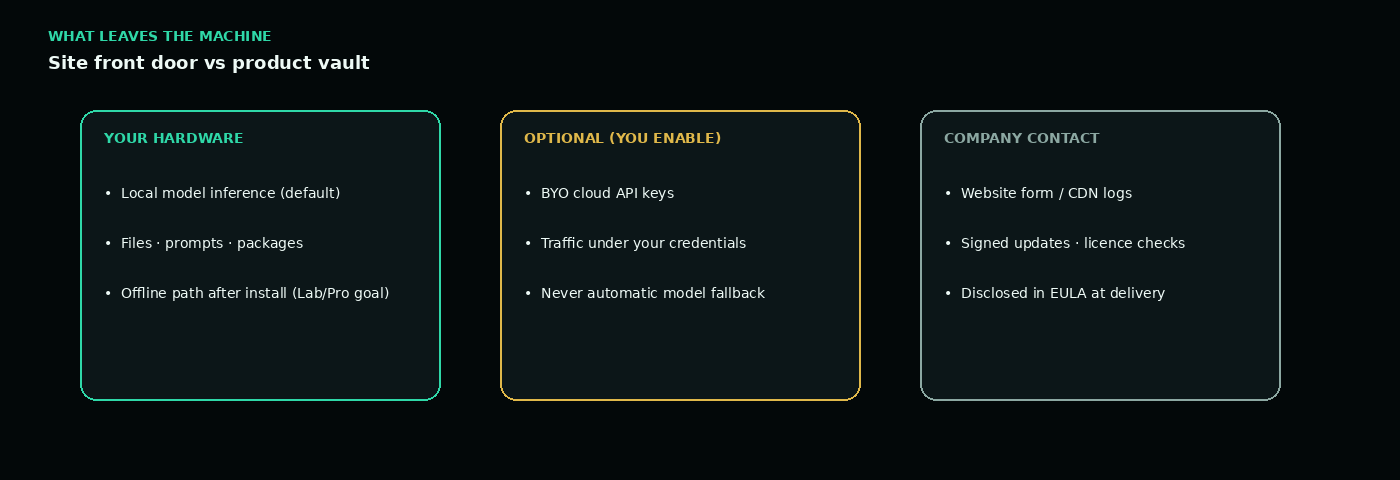
Website: CDN logs, access-form fields, optional consented analytics. See Privacy Policy.
Product runtime: local inference by default. No automatic cloud model fallback. Optional BYO cloud APIs under your keys. Updates and licence checks may phone home when updates exist. Offline use after install is a design goal for Lab/Pro profiles. Ask for the live offline test before large payment (Trust § offline verification).
8. What we keep private
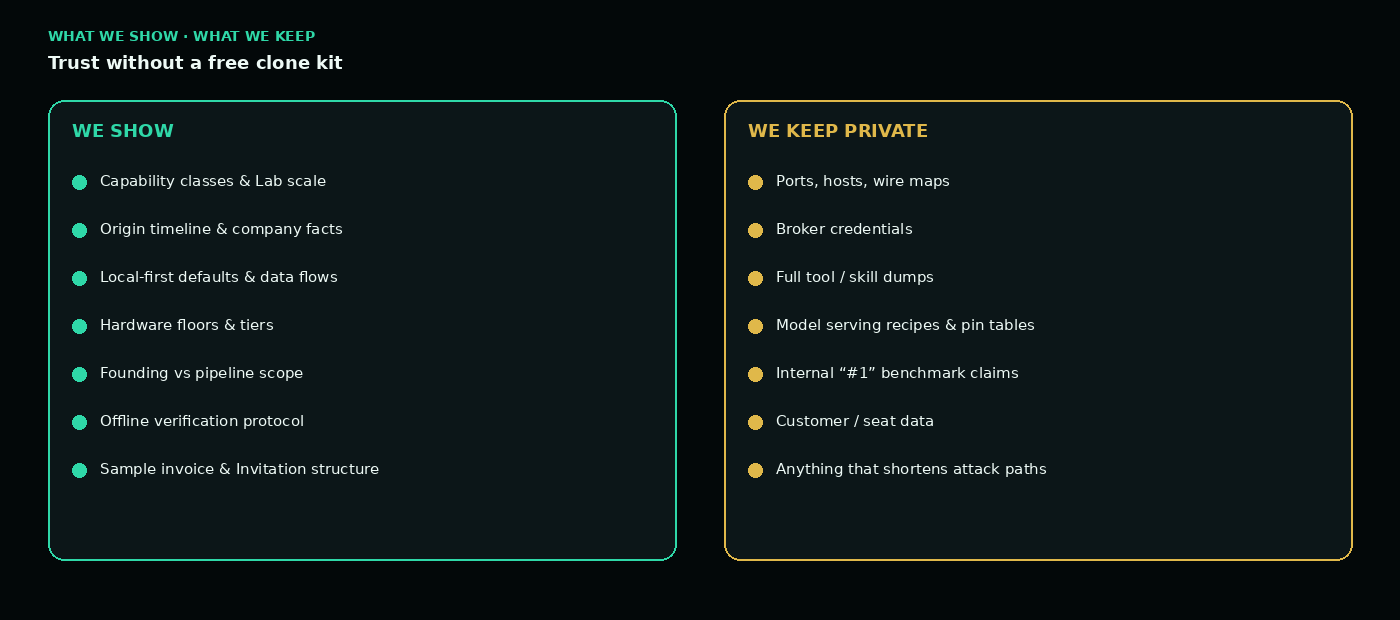
- Ports, hosts, wire maps, broker credentials
- Full tool and skill inventories as a dump
- Exact model serving recipes and pin tables
- Internal benchmarks as “#1” marketing claims
- Customer or seat data
- Anything that shortens an adversary’s path
Public Lab page: si-lock.com/lab. Same rule: show muscle, keep the recipe.
9. Founding Preview scope
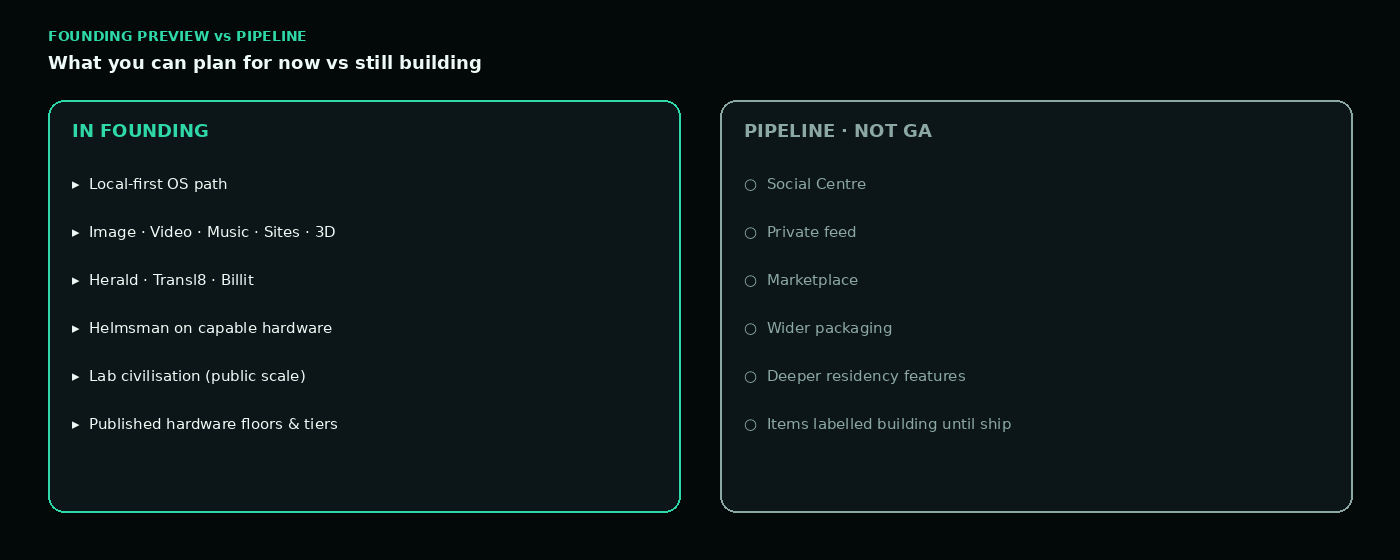
In Founding Preview: local-first OS path; creative suite (Image, Video, Music, Sites, 3D); work packages (Herald, Transl8, Billit); Helmsman on capable hardware; published hardware floors and tiers.
Pipeline (not GA): Social Centre, private feed, marketplace, wider packaging. See roadmap.
No checkout on the marketing site. Contract = written Invitation + acceptance + product EULA. Sample commercial layout: sample invoice PDF, sample Invitation.
10. How to verify
- Company: VF Empire Ltd · C 94160 · VAT MT26384195 (see Trust)
- Company facts and data flows: Trust
- Before-you-pay checklist: Trust §9
- Offline live demo protocol: Trust §10
- Origin short form: Story
- Mail [email protected] for demo and Invitation
© VF Empire Ltd · C 94160 · VAT MT26384195 · Qormi QRM 1902, Malta · S◉LOCK Founding Brief v1.0 · Illustrated public version v1.1 · No secret sauce
Download PDF → · Story → · Lab → · Trust → · Request Founding access →